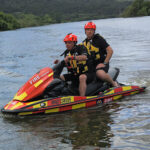


Concern over river safety has escalated following Fire and Emergency New Zealand’s (FENZ) decision to ground the Huntly and Ngāruawāhia rescue watercraft.
In recent correspondence to Waikato District Council Chief Executive Craig Hobbs, FENZ said it cannot currently authorise powered watercraft because the organisation lacks the national systems, specialist staffing, and accreditation pathways required under the Fire and Emergency Act, Health and Safety at Work Act, and Maritime Transport Act. Maritime NZ has also advised that current operations fall outside maritime rules.
FENZ acknowledged the commitment of both brigades but stated it would expose volunteers and the public to legal and safety risks without a compliant national framework. While FENZ continues discussions with iwi, Police and partner agencies, no interim solution has been put in place.
With swift-water capability now suspended and no alternative response available, local leaders have issued public statements outlining their concerns. Below, we publish in full the statements from Chief Fire Officer Karl Lapwood and Waikato District Mayor Aksel Bech (co-signed by the Hamilton and Waipā mayors).
Statement from Chief Fire Officer Karl Lapwood:
IMPORTANT public notice: Please ensure you are aware of the dangers of children or adults swimming in the river and take every precaution to stay safe.
In an emergency, call 111 and a response will be answered.
Note that the Huntly and Ngaruawahia water craft, which you have supported, are not coming as they are under directive from FENZ leadership and grounded at the station.
Our vessels are fully certified, and we want to come. It costs no money to FENZ.
We feel helpless that you are being put at risk. Our options are very tough: respond and give someone a chance of rescue, but we may get stood down for breaking a direct order, or come and increase the chances of survival for an emergency situation.
There was a promise of a solution, but there has been little to no thought put into this decision. They blamed it on Maritime, which was untrue.
Are they waiting for the next drowning? I really feel they don’t recognise our Awa and how this is part of our community and culture.
Urgent Request for Immediate Reinstatement of “Swift Water” Rescue Capability on Waikato Awa
W
e write to you as community leaders of the Waikato to acknowledge Fire and Emergency’s commitment to community safety and to seek a constructive pathway forward regarding powered watercraft and swift water rescue capability on the Waikato River.
Since that correspondence, several meetings have taken place involving Fire and Emergency New Zealand (FENZ), local brigades, Waikato District Council representatives, and community stakeholders. These discussions have consistently highlighted the urgent need for clarity, collaboration, and meaningful engagement on this matter. While we appreciate the efforts made to date, we remain concerned that the pace of progress and clarity around next steps has not matched the urgency of the risk – and now what appears to be a firm decision made in isolation of any collaborative approach.
We seek renewed engagement to ensure a collaborative solution as, despite assurances that the issue was being actively considered, we have seen no substantive response from FENZ leadership after the 30 July meeting at Ngaruawāhia Station regarding any practical alternative arrangements to community risk response, bearing in mind the legal obligations but also operational history by local brigades since 2010 (Huntly) and 2018 (Ngāruawāhia).
This issue is not isolated to our district. The Waikato River is a lifeline for many communities — culturally, recreationally, and economically. The ability to respond to emergencies on the river is not a luxury; it is a necessity. The community has invested heavily in this capability, including over $42,000 raised locally for rescue equipment. The expectation is that FENZ will honour its duty to protect life, not retreat from it.
Megan Stiffler was quoted in the media saying that FENZ had decided it was unable to do the work necessary to support local stations to use the vessels they have:
“Fire and Emergency does not have the capability to operate powered watercraft safely or in a compliant manner with the Maritime Transport Act 1994 or Health and Safety at Work Act. We also don’t have the capacity to stand up this capability,” she said.
Most recently: “[FENZ] are unable to support or authorise the continued use of this capability. Indeed, Maritime NZ wrote to us advising that we are operating outside of the Maritime rules, which is an offence of the Maritime Transport Act.”
We acknowledge Fire and Emergency’s obligations under the Fire and Emergency Act, Health and Safety at Work Act, and Maritime Transport Act. Our intent is not to compromise compliance but to work together to achieve both safety and responsiveness – noting that lack of ability to comply with H&S and Maritime requirements is at the FENZ level, NOT the local brigades who have obtained all appropriate certifications and, we understand, have appropriate H&S training and procedures in place.
Put bluntly, the two local brigades have taken all appropriate steps and appear to be fully compliant – and have successfully completed many potentially life-saving rescues. It is FENZ that has taken the decision that it itself is not compliant and has instructed the brigades not to respond, leaving no alternatives in place.
The FENZ claim that others will respond to a swift water rescue is not consistent with our local knowledge; Police are equipped for recovery, not rescue operations in the timeframes required. Coastguard and Surf Lifesaving do not have jurisdiction or any ability to respond. The Harbour Master is not equipped to respond, nor is LandSAR. By FENZ standing down these two well-equipped, trained and certified brigades with proven incident-free track records, FENZ is in our view putting lives at risk.
In the meanwhile, whilst such new engagement recommences and given the proven capability of the Huntly and Ngāruawāhia brigades and the absence of alternative rescue options, we ask Fire and Emergency to consider an interim arrangement that enables these stations to respond under agreed safety parameters while a national framework is developed.
We remain committed to supporting Fire and Emergency in building a safe, compliant, and sustainable solution. Our communities expect that together we will find a way to protect lives on the Waikato River and we welcome the opportunity to do so.
Ngā mihi nui,
Aksel Bech — Mayor, Waikato District Council
Mike Pettit — Mayor, Waipā District Council
Tim Macindoe — Mayor, Hamilton City Council