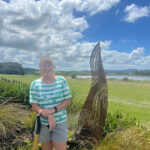

Te Kauwhata resident and environmental scientist Liz Tupuhi leads the charge for a cleaner Lake Waikare and Whangamarino wetlands. Here’s what drives her- and what you can do to help.
Our lake and wetland’s water quality has been a long standing concern for Te Kauwhata- how did you get involved?
The Waikato Regional Council asked me to take on the role of community and rangitahi/youth co-ordinator to develop the Whangamarino, Waikare Action Plan. I’d worked with WRC managing their science teams and department, then moved to manage the DairyNZ science team for a couple of years until Covid hit and I took early retirement.
I then got involved with teaching placed-based science in schools working with Kiri Pengelly, HOD science at TK College. I really value this relationship and always enjoy working with Kiri, the science teachers, Jade the lab technician and students at the College.
Having these experiences made me a good fit for the work in developing the Whangamarino, Waikare Action Plan. This is the first plan that’s enabled rangitahi and community to be involved in what happens with our lake and wetland.
What can we reasonably – and potentially achieve- within the next 10 – 30 years?
It really depends on what people want. Changing the state of our lake and wetland is going to be hard and will require lots of work – and it certainly isn’t a ‘one shot, one action’ solution.
The action plan aims to identify what we need to do as a community to make the biggest environmental difference and when those actions should be taken. It’s the start of a long process aligning with previous work and will involve developing an implementation framework, business cases and work programmes that are likely to take many years to fulfil.
Good achievements would be to control sediment entering Lake Waikare and for koi to be caught in large numbers (with financial return). It’d be great to have places enhanced, allowoing native species to thrive, and for the community to have access to the lake and wetland.
We’re unlikely to be able to swim in it by this stage but it could look a lot better.
What can we do – will it make any difference?
Everyone has a role to play in restoring our environment; the more community members want to get involved, no matter how small, the bigger the difference we will make.
For example, getting involved in restoration work such as tree planting, thinking about how you use water on your garden or farm; are there more efficient ways, less polluting ways? Being vigilant about rubbish and litter also helps.
Can you break that down into action for us?
In an ideal world, we’d see farmers in the catchment using best management practices for their land and water management. Ideally, we’d like to see effluent discharge out of the lake, and good stormwater treatment systems in all new developments.
We need entrepreneurs to take on koi, and scientists who know what to do with algae; engineers to redesign the flood system to bring a more natural hydrology without risking infrastructure. We need to deepen the lake in some way and improve native habitat. Community members with the right skills and a can do rather than a no way attitude would make a huge difference.
What led to your interest and involvement?
I’m an environmental scientist, but this current project arises through having a BSc, Postgraduate Diploma and 30+ years of experience. I didn’t do a PhD, but have been involved in water quality, biodiversity, planning, compliance, restoration of polluted sites and marine oil response (plus much more) over those 30 years.
What’s the Liz Tupuhi backstory?
I came to Aotearoa/New Zealand in 1973 with my parents as 10pound poms- working on dairy farms (why is it Kiwis don’t want to work on dairy farms?).
One of the farms we worked on was adjacent to the Tarawera River, flowing through Kawerau. Upstream of Kawerau it’s a beautiful crystal clear, deep fast-flowing river but downstream it was black and stinking in the late 1970s and 80s.
I hated the change and knew it was because of the mills in Kawerau. This, and having my daughter, is what led me to going to university and becoming who I am.
I married Glen Tupuhi in 2014 and have learnt so much about this area and what it is to be mana whenua of an area; he has enriched my life incredibly. I am also now the proud Nana of 14 moko, every one of them an amazing young person.
How would your (mythical) magic wand change the current situation of the lake and wetlands?
If I could wave a magic wand, I’d turn back time and get our forefathers to leave forests on the ridges and gullies of our hill country and not drain wetlands alongside streams and lakes. I’d then move forward about 100 years and not create the flood scheme as it exists today.
I’d ensure a more natural water flow and finally – coming forward another 30 or so years (to the 1990s) – tell farms they didn’t need to apply as much fertiliser as companies were pushing and that it wasn’t cheaper in bulk, just wasteful.
If it was a powerful wand, I’d also ensure koi and catfish weren’t introduced.
These four things are the main reasons why our lake and wetland are like they are today. The wastewater treatment plant and discharges from our industries haven’t helped, but they’re not main drivers.
Best takeout message for Te Kauwhata?
Get involved. As they say, don’t just sit there– do something! Keep an eye on Facebook and the Chatter for upcoming events. We’d love to see you – and your family- there helping to create a better future
by Claire Simpson