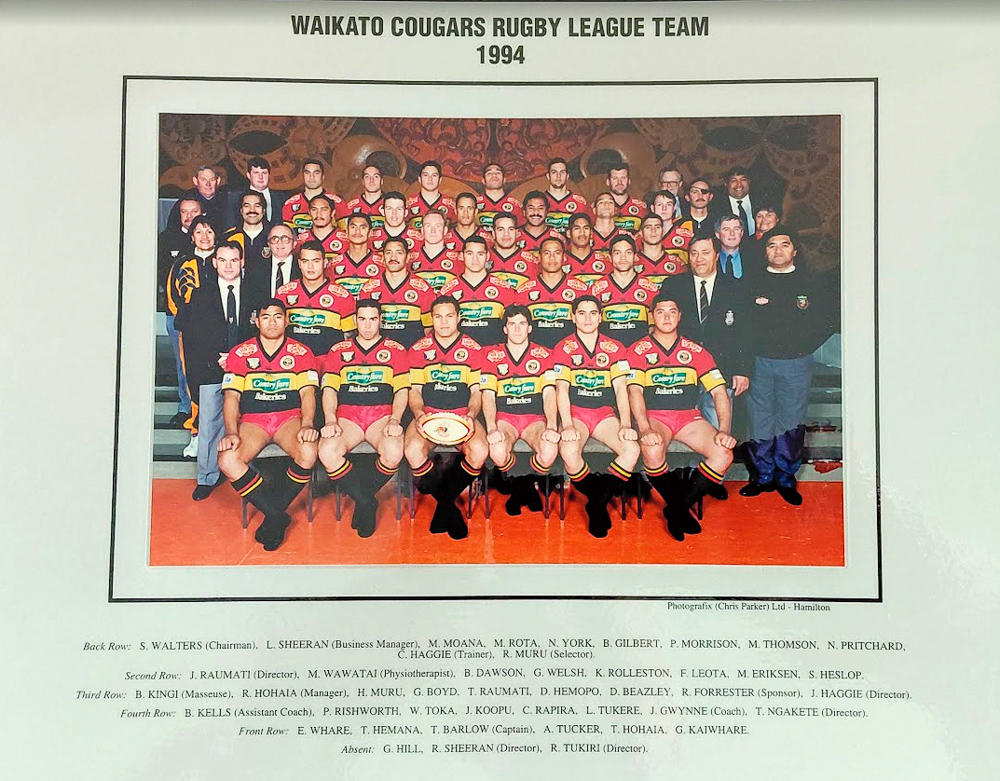

Prior to the introduction of the new kaupapa known as the Lion Red Cup, Waikato representative teams were selected from North v South, Māori v Pākehā, or Married v Singles trial games. The Davies Park trials produced some rather surprising names. Alongside the stock-standard Waikato club personnel were a trio of current rugby players, a renowned Auckland whānau name (Ropati), and a New Zealand representative hammer thrower, Phil Jensen.
Head Coach Joe Gwynne had been signed to begin his contract on 1 November 1993, and local players — although super keen — were in for a rather large shock when called to assemble on 14 November. With the Lion Red Cup set to begin in February 1994, a squad of 30 players were about to embark on a gruelling training regime at the newly acquired Hopuhopu Sports Park, complete with numerous training fields, a gym, assault course and hills.
Ably led by rising Hamilton City Tigers star Tukere Barlow, and with only one of the aforementioned ‘outsiders’ included (Melville Rugby player George Kaiwhare), the squad was comprehensively “upskilled”. Time trials, strength testing and endurance runs were all new to everyone.
Local clubs quickly realised that their best players would not be available come the 1994 season. Coach Gwynne also recognised that to be competitive, he would need to recruit ‘JAFAs’. Francis Leota, Arron Tucker, Gavin Welsh, Mike Thompson and Darryl Beazley were promptly signed, with Kiwis Tea Ropati and Tawera Nikau also in his sights. Nikau was with UK Super League club Castleford at the time, playing year-round as the UK season ran during our summer. Local Huntly South junior Martin Moana was among the first players signed to the Winfield Cup DB Bitter Auckland Warriors — a significant achievement.
Over-indulgence and large Christmas dinners became a thing of the past for the 30 squad members (management were exempt — haha) as the 1994 season beckoned. Three mid-summer games against the Manukau Magpies, Māngere East Hawks and Ōtara whittled the squad down to a playing 17 for the opening game in Waitara against the Taranaki Rockets. This Pepsi Max pre-season three-round knockout competition carried a hefty first prize, which we didn’t collect — ouch — going down 28–22. Paul Rishworth scored the Cougars’ first try — in fact, he scored all four — but the kickers had an off day. James Koopu (RIP) was appointed the first Cougars captain.
Excitement built as the Country Fare Cougars neared the official start of the 1994 Lion Red Cup. A home game at the headquarters of Waikato Rugby League, established in 1937, was scheduled for Sunday 20 March at 2.30pm. For years prior (geez, this is going to get deep), New Zealand lived by the mantra that the Good Lord toiled for six days and rested on the seventh. Sunday was traditionally regarded as a day of rest — yet here was this brand-new competition (rugby league, at that — ouch!) set to unleash 204 physically supreme athletes to bash the living daylights out of each other every Sunday for 25 weeks.
Unheard of! Saturday was New Zealand sport’s day.
But as Bob Dylan sang back in the 1960s, ♫ The times they are a-changin’ ♫.
New Zealand Rugby Football League President Trevor Maxwell officially welcomed everyone to the new competition, extending thanks and best wishes to the teams, district leagues and clubs, while acknowledging “our great sponsors for their commitment”.
Auckland Vulcans v Wellington Dukes opened Round 1 with a Friday night clash at Carlaw Park on 18 March. Other fixtures included Christchurch Shiners v North Harbour Sea Eagles at Addington Showgrounds; Bay of Plenty Stags v Waitakere Raiders at Rotorua Stadium; Taranaki Rockets v Canterbury Cardinals at Pukekohe Domain, Waitara; Hutt Valley Fire Hawks v Counties-Manukau Heroes at Fraser Park, Lower Hutt; and Waikato Cougars v Hawke’s Bay Unicorns at Davies Park, Huntly — all on Sunday at 2.30pm.
Sports betting was another new phenomenon introduced, and match results had to be precise and relayed to headquarters immediately after full time — a task handled by the Business Manager.
Tukere Barlow was anointed captain for the season and was handed the match ball by my 94-year-old grandfather, Wetere Paki, as a symbolic passing of the baton to the next generation.
The team was:
Fullback — James Koopu
Wings — George Kaiwhare, Mark Erikson
Centres — Hekewaru Muru, Paul Rishworth
Halves — Beaumont Dawson, Aaron Tucker
Front Row — Gavin Hill, Tukere Barlow, Mike Thompson
Second Row — Francis Leota, Gavin Welsh
Loose Forward — Martin Moana
Reserves: Dean Hemopo, Blake Gilbert, Stuart Heslop, Cliff Rapira.
I began writing a column in the local “rag”, originally The Huntly Press (later The New Tatler), and editor Pamela Ferla was fairly receptive to the descriptions and anecdotes I penned. Nicknames are a form of flattery, and nearly every player had one — from “The Boss” Joe Gwynne and his sidekick “Yappy” Billy Kells, to “Bam Bam” Stuart Heslop, the baby of the squad.
James Koopu was “Go Gas” (he worked at the Mobil service station), Aaron Tucker was “Mouse” due to facial features and stature, Mike Thompson was “Bucket” (having carried the Auckland forward pack against Australia, Great Britain and France), and Tukere Barlow was “Duke” from his City Tigers days. Dean Hemopo was “Nugget” (not acceptable to some nowadays, but I still call him that), Gavin Hill was “Benny” after the TV comedian, and Mark Erikson was “Tanalised” — as in needing preservation.
Others included “Inga” Martin Moana, “Spider” Darryl Beazley, “Chainsaw” Tony Waikato, Eru “Mansion” Whare, “Asphalt” Cliff Rapira (hard as nails, worked in roading), Beaumont Dawson — “Phoenix” (palm tree hairstyle), Blake Gilbert — “SAS” (self-appointed), “Portrait” Paul Rishworth (covered in tattoos), “Flash” Hekewaru Muru, “Chukka” Shane Hill, “Robocop” Glenn Boyd, “Twinkletoes” Tama Hohaia, and the grandaddy of all nicknames — “Restaurant” George Kaiwhare.
There were also the adaptive nicknames: “Franco” Francis Leota, “Coona” Terry Clune, “TJ” Tony Hemana, “Gavvy” Gavin Welsh, “Softly” Nathan York, “Tarzan” Tahanga Raumati, “Porsche” Paul Morrison, and last — but by no means least — “Doongy” Mark Rota… which I won’t elaborate on.
So stay tuned, whānau — there’s much more to come.
Researched by Rex Hohaia
21 October 2025