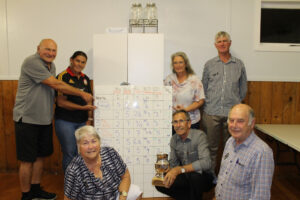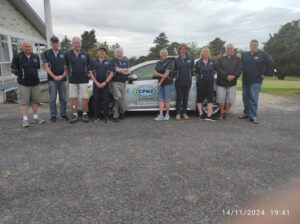

Tuatahi he mihi atu tēnei ki te tangata Joe Wade. Joe was appointed as the original Football Team Manager for the Cougars. He tragically passed away in late 1993, doing what he loved; playing rugby league at League Park, Ngaruawahia, during an Annual Awards weekend where a Club Captains’ Selection played a Presidents’ team. Moe mai rā e hoa….
Born out of an idea in the early 90s that a national weekly competition should be held, with games regularly televised and ‘healthy’ sponsorship deals on offer, the game of rugby league was about to undertake some major changes in Aotearoa. Having seen the rise in popularity of the 1980s’ Wrangler Cup and Tusk Cup as end-of-season Champion Club competitions, the NZ Rugby League decided to anoint Graham Carden as General Manager to facilitate said competition. To be called the Lion Red Cup and set to commence in 1994, it would involve a $4 million budget and 12 teams with major jersey sponsors on board, along with high-profile coaches.
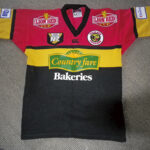
The Auckland City Vulcans (CRC, coach Gary Prohm), North Harbour Sea Eagles (Just Jeans, Graham Norton), Counties Manukau Heroes (Enzed Hose Doctors, Stan Martin), Waitakere City Raiders (FM Country Radio, Ron O’Regan), Wellington City Dukes (Projex, James Leuluai), Hutt Valley Fire Hawks (Firestone, Tyrone Paikea), Christchurch City Shiners (Wastecare, Wayne Wallace), Canterbury Cardinals (Cardinal Network, Gerard Stokes), Bay of Plenty Stags (Sportsmans Hotel/Sports Signco, Neil Joyce), Waikato Cougars (Country Fare Bakery, Joe Gwynne), Taranaki Rockets (Smokefree, Teri Tamati) and Hawkes Bay Unicorns (Super Liquor/Terminus Tavern, Gary Kemble) were set to be unleashed onto the New Zealand sporting public…… But a ‘new kid on the block’ was lurking!
The concept began with a hiss and a roar; in fact, it sparked a ‘breweries war’. Lion Red, whose parent company Lion Nathan had been a long-time supporter of rugby league, had been hoodwinked by competitor DB Breweries, who were the major sponsor of this ‘new kid on the block’, the DB Bitter Auckland Warriors, who were about to enter a team into the Sydney competition. The Australian Rugby League’s Winfield Cup had been on people’s television sets since the mid-80s (on Channel 2 at 11pm – ouch!) and many ‘followers’ would conduct an annual pilgrimage to the September Grand Final in Sydney. The State of Origin had also had a massive following on both sides of the Tasman since its inception in 1980, and this one-town, one-team franchise was about to enter that Australian Winfield Cup in 1995.
This, of course, did not go down too well with the Myers family, who had been in the game since Adam was a cowboy, and the immediate effect was that the game, once classified as a game for thugs, was front and centre of the evening news as these two giants of the liquor industry tried to outdo each other. Promotional events sprung up left, right and centre. The DB Auckland Warriors conducted a pre-season camp at the Te Rapa Air Force Base (where Te Awa now sits) and every man and his dog was there to observe…
Meanwhile, the newly named NZRL Lion Red Cup began to take shape in late 1992. This semi-professional competition would see local players signing legally binding contracts and team coaches being paid, with each franchise having a Development Officer who would be in the playing ranks and introduce the game to primary and secondary schools – a domain untapped for years previous. The Warriors had signed Canterbury Bulldogs prop Gavin Hill for their inaugural 1995 season and he was assigned to the Joe Gwynne-coached Waikato team.
It became ‘fashionable’ to have a mascot associated with every team and a ‘naming’ competition first picked the Waikato Chiefs, but a prominent Māori elder, Binga Haggie, stated, “You can’t be a chief overnight!” so that tag was dropped pronto and the Waikato Cougars was born (although the team was tagged ‘pussycats’ when beaten – haha). Ross Forrester, General Manager of Country Fare Bakeries in Frankton, was only too happy to jump on board as the main jersey sponsor. An official launch was held at the Red Gables Tavern in Te Rapa with a full-page advert the following day in the Waikato Times, edited by reporter Terry Power.
A number of Huntly businesses signed on as second-tier sponsors, including Glen Afton Sports and Citizens Club, Huntly South Sports Trust, Medlab, Great South Investments, Simpson Bus Service, Tainui Trust Board, Challinor and Staines, Doug Morris Appliance Court and Major Decorating. Whilst many league followers had never heard of Country Fare Bakeries – “Best taste by a country mile” – it did cause a hiccup. In the past, rep players travelling north or south were ‘picked up’ outside Shands’ Bakery on the Great South Road in Huntly. That practice had to be abandoned – geesh! Talk about sponsor overkill!
Throughout the 12-team competition, all franchises consisted of a squad of 30 signed players. The 1994 Waikato franchise consisted of Joe Gwynne (Coach), Bill Kells (Assistant Coach), Rex Hohaia (Football Team Manager), Rick Muru (Selector), Lance Sheeran (Business Manager), Campbell Haggie (Trainer), Bessie Kingi (Masseuse), Monty Wawatai (Physiotherapist) and David Young (Doctor). A six-person Board of Directors consisting of Chairman Stan Walters, Johnson Raumati, Robert Tukiri, Tahi Ngakete, Janet Haggie and Roy Sheeran registered the Waikato Country Fare Cougars as a company. Nath Pritchard was Media Liaison.
All 30 players were signed to a standard contract of $150 per win, $50 per loss (petrol money). Development Officers received an annual base rate salary of $10,000 plus vehicle and fuel card, and coaches were paid $20,000 plus vehicle and fuel card. Everyone was supplied training gear, tracksuit, runners and boots, with management being the ‘paupers’ of the franchise. It was compulsory to wear sponsor gear at all times. Kangaroo courts were a long-held footy tradition (and a heap of laughs!) and the Pussycats Social Club ‘slush fund’ soon began accumulating a healthy bank balance as players and management struggled with this new, semi-professional approach to conducting a footy franchise.
The 1993 WRL season produced a record score in the Grand Final at Davies Park when Hamilton City Tigers mauled the Ngaruawahia Panthers 50–10, and all players were primed to be in Joe Gwynne’s Cougars team come kick-off in 1994. The inaugural NZ Māori tournament was held in Wellington over Labour Weekend 1993 and a very young Stevie Boy Berryman had been ‘signed’ by Manly Warringah coach Bob Fulton, whilst all remaining Waikato Māori team-mates returned home. Trials were immediately held at Davies Park with enough players to fill six team cards with 10 reserves each. Trials convener Cecil Kells, head coach Gwynne, along with local ex-Kiwis Rick Muru, Billy Kells and Vaughan O’Callaghan, set about moulding an inaugural Cougar squad to enter this ‘brand new’ Lion Red Cup.
Companies that would not have had anything to do with the local league scene in the past were suddenly appearing out of the woodwork as a national interest began to take hold. Radio stations were clamouring to have players ‘in studio’ for interviews. In October 1992, local radio station executive Grant Hislop from Hamilton’s Rock 93FM urged Waikato to aim even higher than having an entry in next year’s Super League. “We want to be the second New Zealand team in the Winfield Cup,” he said at a Ngaruawahia meeting of clubs. Stating that he had 10 company shareholders intending to invest $5,000 were words never heard before at a Waikato RL club board hui… and so it proved to be – all whoey!
….so stay tuned, whānau. There’s lots more to come.
Researched by Rex Hohaia
25 October 2025