The Hamilton Rugby League has had a varied existence over the years and has continually battled the ‘big brother/little brother’ syndrome. Even today, the crowds that attend a rugby league game in Hamilton are well down on crowds that attend rugby union games.
The neighbouring Lower Waikato (read South Auckland/Waikato) Rugby Football League (est. 1911) had its headquarters at Ngaruawahia originally, and games were spread through the northern area, including Huntly and the outlying coal-mining settlements of Rotowaro, Glen Afton, Pukemiro and Renown, with the rural farming outposts of Taupiri, Orini and Komokorau adapting.
Records show that on Monday, August 2, 1920, at 7.30pm, a first meeting was convened at the Hamilton swimming baths’ office “for the purpose of selecting a committee and forming a Rugby Football League Club”, comprising the districts of Taumarunui, Rotorua and Thames, with all clubs affiliated and having Hamilton City as its headquarters. Each area had delegates to represent it, and the election for the first committee resulted as follows: Patron, the Mayor, Mr JR Fow; President, Mr W Stevens; Secretary-Treasurer, Mr J Dowley; Committee, Messrs F Pearson, F Hawke, W Hurrell, R Woods, L Lord, W McDermott, F Innes, F Wilson, J Graham, S Ellis and M Randrup.
The first games were held at Hinemoa Park, just across the road from Rugby Park. The Vernel Bros earthmoving business helped develop that area with a horse and scoop and also utilised a private paddock near King Street. The Claudelands Showgrounds and Steele Park were other venues used.
By 1925, there were six teams involved: City Rovers, Athletic, United, Frankton, Whitiora and Maritime – a couple of those names synonymous with Auckland clubs. There was also a need to become an incorporated body, and the Hamilton Rugby League Inc. came to be. This permitted players ‘of ability’ to represent the national team, known since the game’s establishment in New Zealand in 1908 as the All Golds.
Clearly, “All Golds” was a play on the amateur “All Blacks” name, but it was also a perceived insult to the players, criticising the arrangement where they were paid for time lost off work through injury or paid a portion of any touring party profits. The name “All Golds” is thought to have originated in a New Zealand newspaper in May/June 1907, amidst editorial arguments over whether it was honourable for the proposed “professional All Blacks” team to be paid.
The Hamilton Rugby League Inc. struggled financially through those early years (what’s new? – ouch!), as illustrated by entries in minute books. World War I and the Great Depression made sure everyone ‘struggled’. One year, the financial statement showed a debit balance of £1 17s 9d, and several attempts had been made to boost finances by minor 5s gambling plungers in the Art Union, but to no avail. As a desperate endeavour to stay afloat, the League joined with the Rugby Union and applied for a totalisator permit from the Waikato Trotting Club, with any profits being divided equally amongst the three bodies.
In reply, the then Minister of Internal Affairs, Mr RF Bolland, said, “While I am in entire sympathy with your League and the Rugby Union in your desire to erect suitable stands on the Hamilton Domain, I regret I cannot grant your request.” The reason given was that there were no spare trotting licences, all having been taken up by other clubs. However, the Minister granted permission for the League to raffle ‘works of art’ … (reminds one of having to sell ‘chook raffles’ in the Huntly pub to raise funds for the grandstand at Davies Park in the 70s).
By 1929, support had fallen away so rapidly that Athletic and a new team, Albions, combined to become the Hamilton Rugby League representative team. It also transpired that it was around this time that Hamilton was combining with South Auckland/Waikato teams to play rugby league.
A highlight in 1931 was the Australian Eastern Suburbs v Waikato game at Steele Park. So keen were the players to engage with Australian clubs that a Māori team from Huntly called Kia Ora was ‘brought in’ to keep the game alive in Hamilton.
Through the 50s, 60s and early 70s, Hamilton RL continued with a ‘hotch-potch’ of clubs that would start up with a hiss and roar and peter out over time. Through the late 70s, such clubs as Chartwell Lions, Whatawhata Wolves, University, Tauira and Railways, and those further afield, including Cambridge Raiders, Kiokio Hunters, Te Kuiti Rams, Otorohanga Tigers and Waipa Wildcats, were all established but failed to hold numbers and had to disband.
In 1975, the Hamilton Rugby League was formed (again!) to control rugby league based in the city. Clubs were established and, as it became stronger, the New Zealand Rugby League felt a joining of the Hamilton and Waikato Rugby Leagues was desirable. Both leagues were in agreement over this matter, but it was delayed because, at that time, the Waikato Rugby League had built a new grandstand at Davies Park and was paying off ‘debt’, and the Hamilton Rugby League felt that it should not be involved in that financial burden. The Waikato Rugby League did not want to become involved in any similar venture in Hamilton either.
In 1982 and 1983, a trial joint one-round competition (known as ‘the Big Round’) was conducted by a small committee, with both leagues retaining their own boards and competitions, because the idea was being promoted that the two leagues (Hamilton and Waikato) should combine to form a more teams/more variety concept. This was driven primarily by the Huntly/Ngaruawahia clubs, but they struggled to find support within the Hamilton sides, initially because of the Davies Park grandstand debt.
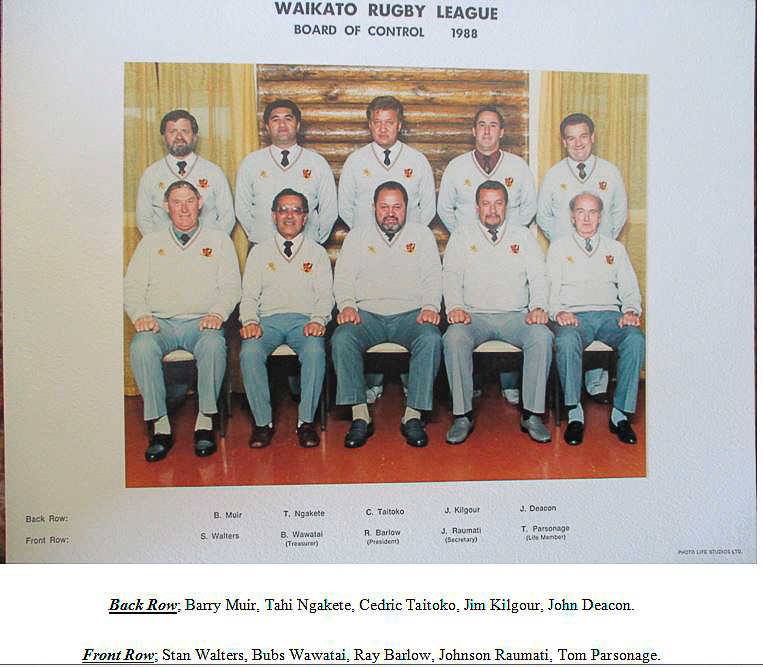
On Monday, 12 December 1983, at the Waikato AGM in the Huntly United clubrooms, President George Dow vacated the chair to allow NZRFL President Ron McGregor the opportunity to instruct the meeting to elect the inaugural combined Waikato Rugby League that we know today. Seventeen clubs (11 from Hamilton) were present, and the first elected members included: Patron, Dr Ash Symmons; President, Mr Ray Barlow; Secretary, Mr Johnson Raumati; Treasurer, Mr Andy Gamble. The committee comprised three northern delegates – R Tukiri, J Deacon and T Parsonage – and three southern delegates – B Muir, G Rehua and J Collins.
Common sense prevailed eventually and, by the 1984 season, the two estranged partners climbed into bed together and lived happily ever after … well, not quite! There was still an air of discontent.
In 1994, the Lion Red Cup swept the previously well-patronised NZRL provincial competition under the mat (read bed!), and more rejigging was yet to come. By 2002, a new sheriff rode into town and formed a de facto relationship. This was the year of the WaiCoaBay affair, which saw all the premier clubs of the Waikato, Coastline and Bay of Plenty provincial unions play a home-and-away series under the control and sponsorship of the NZ Rugby League. Travel and playing gear sponsorship ensured that this affair would signal a new era that would ultimately see all club teams partaking, but, as with any affair … the thrill dried up and so too did the money!
What will the future hold, whānau?