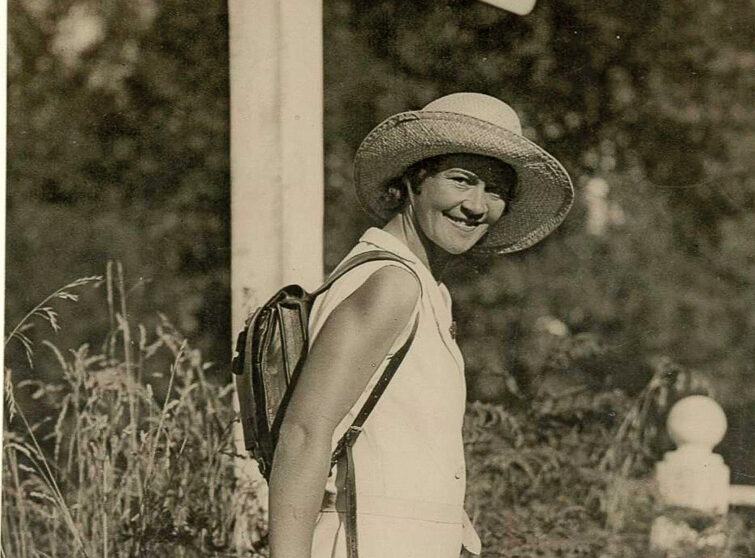
She was the first person to walk the length of the country, which is remarkable in itself. But she did so in 1931–32, during the Great Depression, wearing only New Zealand-made clothes and eating only New Zealand-produced food to encourage people to ‘buy local’.
She then walked from Melbourne to Brisbane.
Meet Esther James, whose walking feats are the subject of author Ian Dougherty’s latest book. The following edited extract covers the North Waikato section of her New Zealand walk.
James made a slight detour to Pukekohe, where she was the guest at a pay-to-attend reception and social at the Oddfellows’ Hall, organised by the Pukekohe branch of the Women’s Institute.
She was met by town clerk S. Bish and welcomed by mayor John Routly and H.H. Pattle from the Chamber of Commerce. She delivered an address about her experiences during the walk and listened to songs and readings by locals.
After supper, the evening concluded with the singing of ‘For She’s a Jolly Good Fellow’, ‘Auld Lang Syne’ and the National Anthem.
James stayed with the president of the Pukekohe Women’s Institute, Mrs J.H. Wyatt. Before walking to Mercer the following day, she was shown around a large farm where potatoes, onions and pumpkins were grown.
From Mercer, James walked to Te Kauwhata, collecting blackberries from the roadside and sending them home to her mother in Auckland to bake into blackberry and apple pie.
James noted that, as she walked along the hot, dusty roads, it was a great temptation not to stop under a shady hedge and eat the wild blackberries.
When Esther James walked into the small settlement of Rangiriri on her way to Huntly, she had covered 400 miles, noting in her logbook: ‘A new town each day’.
In an experience reminiscent of her first day walking through the wilds of Northland, when she had felt almost defeated and all alone, miles from anywhere, she now felt like cheering in the middle of the road. But there was nobody to hear her, so she simply walked on.
At Huntly, James was received by mayor Edgar George and spoke that evening at the local picture theatre.
About three miles outside Ngaruawahia the following day, she was met by mayor Herbert Sampson, who escorted her into town, where she was welcomed at an evening social.
Hamilton-bound the next day, she stopped at Horotiu and inspected the local freezing works.
James was met on the outskirts of Hamilton by the South Auckland Caledonian Pipe Band and Hamilton Girl Guides, who escorted her into town.
It had become known that James was a former Ranger in the Girl Guide movement, and the guides continued to support her as she made her way south.
James was met in the town centre by mayoress Claudine Pinfold, with whom she stayed. She spoke at a civic reception in Alexandra Hall, where she was welcomed by mayor and local doctor Francis Pinfold.
He said: ‘Her advocacy in the encouragement of New Zealand-made goods was a most commendable one and one that should have the support of every loyal New Zealander. She was walking as a missionary to tell the people that the goods made in New Zealand were as good as those of any other country.’
James also spoke on Hamilton radio station 1ZH.
New Zealand Maid: Esther James and Her Campaigning New Zealand and Australian Walks During the Great Depression is available from bookshops or directly from the publisher at saddlehillpress@xtra.co.nz for $40, post-free.