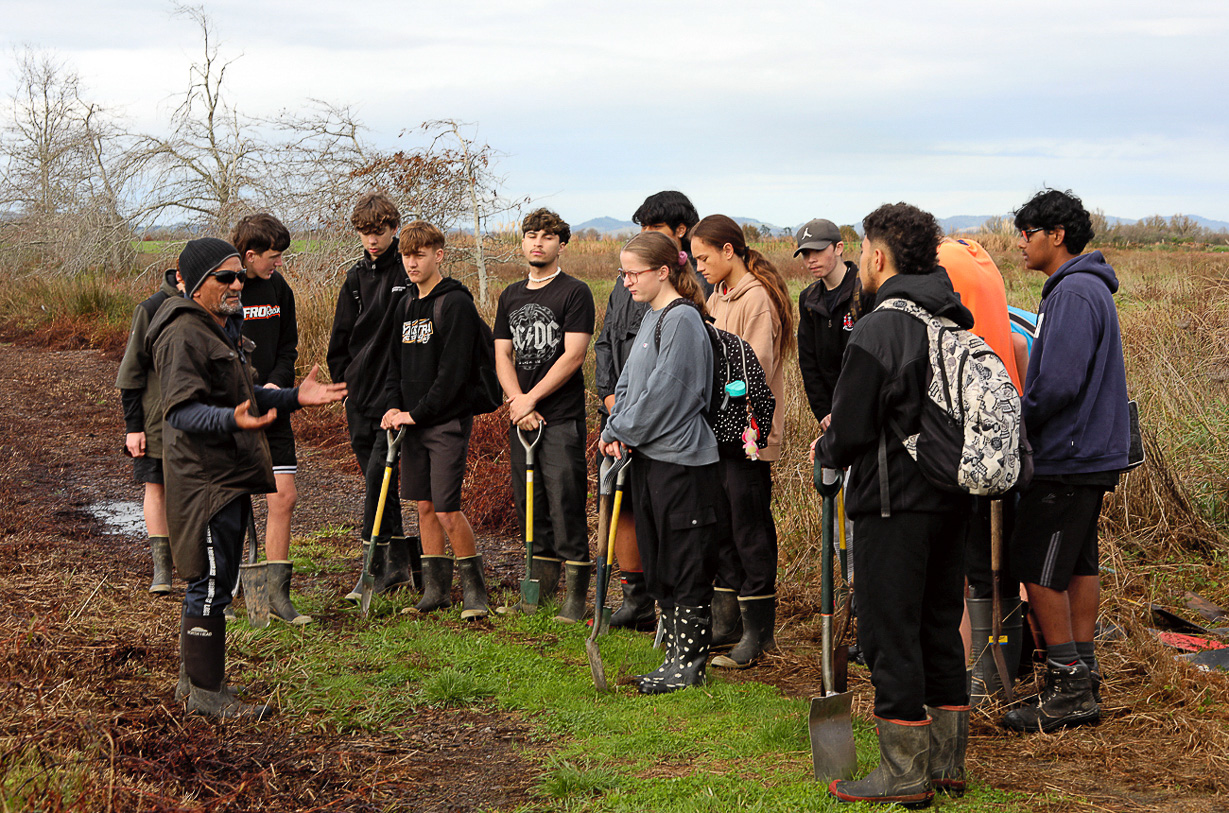
We are now at the stage where the Lake Waikare and Whangamarino Wetland Action Plan is in its final draft and this month we will be running some open days to enable further discussion of what this means for our community. Keep an eye on our facebook pages (Te Kauwhata, Meremere and Lakeside) for more information about these open days.
How did our lake and wetland get so degraded?
As a westernised community we had economic and social needs that led to significant changes being imposed on our environment. These included modifying the Lake and Wetland’s water flow and levels to help protect our growing community from flooding, and to make a living via farming, which also meant that wetlands were drained, hills were cleared of forests and fertiliser was applied to improve grass growth. Erosion occurred as a result of changes in land cover and use, sediment which once might have deposited in wetlands along a streams course, was transported from hills to the lake and Whangamarino wetland.
Some people get stuck on idealistic ideas about what we should be able to do in a country for Stewart Joseph Smith from East London he thought that everyone should be able to fish like he used to as a child in London. This lead him to become one of our most damaging environmental vandals. Over many years he introduced many thousands of fish to our waterways, and it is most likely that he introduced koi and catfish to both the lake and wetland and the streams and drains that connect them. As the koi population has grown they have displaced our native taonga/treasured species, such as eels/tuna, inanga/native fish as well as kaeo/freshwater mussels and along with other influences (loss of habitat and feeding areas) Australasian Bittern/Matuku huurepo and other wetland birds.
Koi also damage stream and drain banks, causing problems for our farmers who have to try to control their impacts. And along with wind they stir up sediment in our shallow lake, making it turbid a lot of the time.
As a community we can no longer use the lake and have very limited access to it,, and the wetland. The Action Plan aims, over a number of generations, to address these issues in the hope that our great grandchildren/mokotuaroa will be able to once again enjoy boating, swimming and food gathering in the lake and wetland.
How will the Action Plan help?
The problems are interrelated and complex, there is no simple fix.
The Plan has identified actions that will help to address the state of our Lake and Wetland. Some of these actions are simply good management/ kaitiakitanga/ stewardship of our land, others require much more work to be done. In particular actions identified as “Transformative” will take many years to develop and implement, but they are the actions that will make a transformative difference to the current state of the both waterbodies.
The action plan is not statutory, meaning no one will be forced to do anything as a direct result of the plan, but if we do nothing the condition of the lake and wetland will only get worse. Implementation of the actions identified will fall to the institutions who do have statutory requirements to look after our conservation land and water – DoC, Fish & Game, Waikato Regional Council and Waikato District Council. The Waikato River Authority, Waikato Tainui, mana whenua, land owners and the wider community will need to be closely involved. The Plan identifies that a governance body should be established with representatives from all of these sectors. The work the governance will undertake has yet to be determined, but will likely be to determine what when and how actions should be taken. The implementation of the plan is your chance to be involved, it will take years, it will certainly cost money and we will need central government help, but more than anything we will need a whole of community approach.
Come along to an open day (remember keep an eye on the FB pages for dates, times and places). Learn what you need to know and if you have a great idea feed it back to the team.